Ten educative Facebook groups about childhood

librarianbyday at flickr

During our learning journeys about childhood, it is helpful to belong to a community where the subjects are being debated, so that we can experience other people’s viewpoints and put into context what we are studying individually.
Facebook groups can be just as useful for learning as they are for social networking – in fact, it would be hard to avoid learning from many good ones.
Here are ten open Facebook groups that offer good, supportive communities for different aspects of childhood. The list reflects my own interests so it is not comprehensive, but it may be useful to view them as a quality benchmark when looking for groups in the topics you are interested in.

These groups share common characteristics that make them stand out as well-developed communities offering opportunities to learn from others. They are all open; many features clear rules for participation and all the groups are well-moderated by administrators, so there is very little spam. In addition, the groups often include an archive of topical resources in the ‘files’ tab, and each features a range of members participating and contributing to discussions.

If you don’t yet  belong to a community that supports your individual learning and development, any of the groups listed above would be a good place to start.

Autistic Spectrum: Free e-learning modules

3492401705_0fe96f78c5_qInterested in studying the Autism Spectrum from your own home? Here are three free options from reputable institutions.

Autism Spectrum Disorders by the Geneva Centre for Autism in Canada
These are an attractive suite of nine free modules aimed at parents and those working with school-age children and young people. They are well-structured with learning outcomes, quizzes, audio, video and printable handouts. The modules are delivered through a Moodle VLE (Virtual Learning Environment) and are available in both English and French.
The only aspect I’d question is the simple requirement to enrol, which I hope doesn’t deter any users from these excellent resources.
Link: http://elearning.autism.net/
I’d recommend that beginners take one of these Geneva Centre modules prior to embarking on either of the following two modules from the OU or MIT.

The autistic spectrum: from theory to practice by The UK’s Open University
This 20-hour module is also delivered through a Moodle VLE platform, but is pitched at intermediate level – equivelent to the second year of a Bachelors degree. It is well-structured with learning outcomes and seven activities, comprising mostly text and diagrams rather than audio or video.
The whole module can be downloaded for offline use, and the Open University’s LabSpace allows you to adapt the module to your particular requirements and then share it with others.
Link: http://labspace.open.ac.uk/DSE232_1_2.0

Autism Theory and Technology by Massachusetts Institute of Technology (MIT) in the USA
This is MIT’s eight week long module as delivered in Spring 2011 at graduate/masters level. As indicated by the title, it explores the use of state-of-the-art technologies alongside Autism.
In contrast to the two Moodle VLE-based modules above, this module was designed for classroom delivery and participation. It comprises a single two-hour lecture video, syllabus and readings, but there is no interaction if you’re studying alone as there are no quizzes or tests. All the module materials can all be downloaded for offline use.
Link: http://ocw.mit.edu/courses/media-arts-and-sciences/mas-771-autism-theory-and-technology-spring-2011/index.htm

Creative Commons Licence All three of the above are licensed under a Creative Commons Attribution-NonCommercial-ShareAlike 3.0 Unported License.  Ribbon by Beverly & Pack

Rosie: the child protection computer game

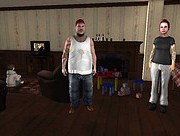
rosie 1 screenshot

Rosie 1 is based upon a real child protection home visit by a social worker. Although the visit initially appeared benign, the social worker is exposed to unexpected people, reactions and events as it progresses.
This ‘serious game’ developed by social work researchers at the University of Kent provides a safe new medium to explore child protection assessment and offers professionals, at different stages of their careers, a unique way to evaluate child protection situations.
The 3D virtual reality technology offers those involved in child protection the opportunity to evaluate and re-evaluate child protection situations safely and try out other ways of behaving or reacting to a situation, without serious consequences, or anyone else seeing and commenting. It enables participants to move around the environment to be assessed, explore features of the house in which the child resides and study conversation choices and subsequent reactions from the other characters.

Rosie 1 took me about 10 – 15 minutes to complete initally, and longer when I began selecting and thinking about the different approaches. Each time it was a realistic and thought-provoking experience that I would highly recommend for developing social work skills. I think I’d have found the experience even better if an instruction sheet were available that could be printed and kept alongside the computer whilst installing and playing.

This prototype was released in June 2011. It is currently a free 57mb download, and the minimum requirement to run the game is Windows XP – the prototype is not Mac compatible. Rosie 2, the University of Kent’s follow-on serious training game is available to purchase online from £200 at http://www.kent.ac.uk/sspssr/ccp

Download and play the free Rosie 1 from www.kent.ac.uk/sspssr/ccp