
Category Archives: Course

Parental substance misuse

Parental substance misuse 1

The Social Care Institute for Excellence’s (SCIE) Parental substance misuse elearning resource is designed to support social workers responsible for ‘children in need’ when working with families where a parent or parents are misusing drugs or alcohol. Parental substance misuse is an important issue that social workers encounter frequently – one study estimated that between 250,00 and 350,000 children in the UK had a parent who was a problem drug user, and that 62% of children subject to care proceedings had a substance misusing parent.
This elearning resource provides social workers with enough information to be able to make judgements about the possible impact on children that they are responsible for. The package is presented in an accessible and engaging way, and comprises three modules:

  • Understanding substance misuse
  • Understanding the impact on children
  • Implications for children’s social work practice

Each module is about 20-30 minutes long. They include glossaries, references, transcripts, learning records and links to extra resources. Adobe Flash Player is required on your computer.
Link: www.scie.org.uk/publications/elearning/parentalsubstancemisuse/index.asp
Use of this resource, and import of the resource into learning management systems, for educational purposes is freely permitted. A SCORM version is offered for free download and use in a virtual learning environment (VLE).
Positive Behaviour Supports for Children with Disabilities
PBSC_family_croppedPositive Behaviour Supports for Children is a series of three, related e-learning websites developed in 2012 by Canada’s Alberta Government and Mount Royal University for use by families, aides and school staff that offer practical, evidence-based strategies for supporting children with disabilities and their families.

The Family Portal was written by parents for parents and includes strategies related to:
Promoting adaptive behaviour, learning and development;
Minimizing and managing challenging behaviours;
Working effectively with service teams both at home and at school;
Planning for common life transitions; and
Maintaining and improving the well-being of the entire family.

The portal features explicit learning outcomes, interactive exercises and quizzes, and comprehensive literature references and links to resources. Each unit of the seven Modules has it’s own pdf manual that can be downloaded or printed, and there’s also a complete 356-page colour PDF version of the entire content of the Family Portal .

The Home/Family Aide Portal  has 5 modules in a similar format. I experienced some some server location glitches when using this Portal, and some of the unit manuals still have authoring comments showing. The School Staff Portal has 7 modules with an emphasis on Fetal Alcohol Spectrum Disorder.

I’d expect the Family Portal to be the most popular of the three websites. It provides easily accessible information to parents and caregivers of children with disabilities such as Autism Spectrum Disorder, Fetal Alcohol Spectrum Disorder, Down Syndrome, Fragile X, and others. This is not a website to work through in a single session, which might take a month! Instead, it is designed to be a resource you can turn to whether you have just ten minutes at a time or several hours. It is also designed to be flexible – you can skip the theory behind some of the strategies if you are already familiar with it, or you can read more about it to increase your understanding.

Link to PBSC websites: www.pbsc.info

The PBSC websites require Flash Player and are not compatible with mobile phones. The websites are Copyright 2012 with All Rights Reserved but permission granted to reproduce for personal and educational use only.

An Awareness of Child Abuse and Neglect

A free e-learning course for anyone, including members of the public, who would like to know more about the signs and symptoms of child abuse and what to do if you suspect a child is being abused or harmed.
The course should take approximately 40 minutes to complete including a knowledge check at the end. Once you score 100% in the knowledge check you will be able to print a certificate of achievement.

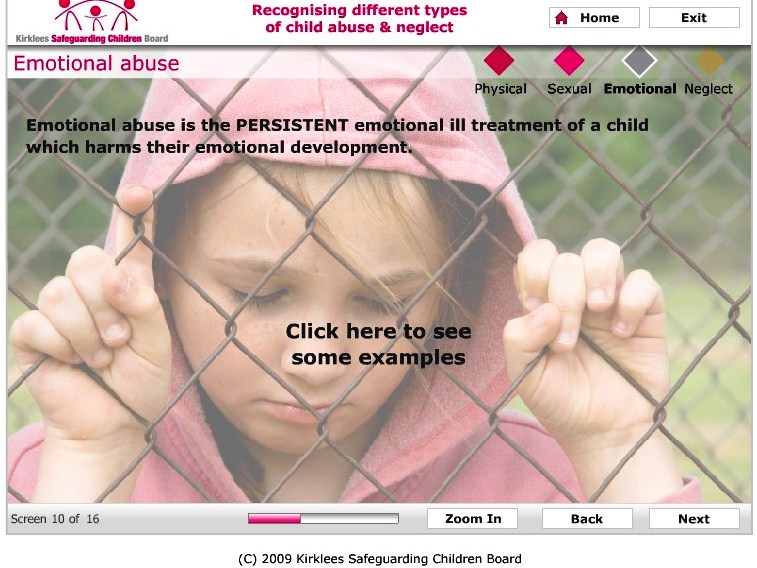
This 2009 course by Kirklees Safeguarding Children Board has explicit learning objectives and is arranged in four lessons, followed by a final knowledge check. Whilst it is free, you do have to register to use it, selecting ‘member of the public’ when prompted. The course is very interactive, but I was surprised it had no accompanying audio. Nevertheless I would highly recommend it, particularly for volunteers and sessional workers.

Link to course: www.kirkleessafeguardingchildren.co.uk/e-learning-course.html
All Rights Reserved Copyright © 2012 by Kirklees Safeguarding Children Board