Tufts Child & Family WebGuide

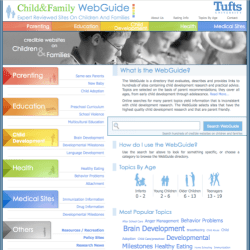
tuftscfwgThe WebGuide is a directory of quality websites covering all ages from early child development through to adolescence.

Tufts University have assembled approved links to websites and videos on topics of interest to parents. It is also used by students and professionals in the fields of child development, education, and psychology. All the sites and videos listed on the WebGuide have been systematically evaluated by graduate students. In order to ensure reliability, the evaluation system includes criteria such as the inclusion of citations in peer-reviewed journals.

This really is a very reliable resource for students and workers’ continuing professional development (CPD). It is easy to navigate, with drop-down menus across the top of the site. For example, ‘Health’ includes ADHD, Autism and Aspergers.

The WebGuide has been systematically evaluating links since 2001, so it has now amassed a substantial collection. Tufts’ evaluation criteria are rigorous, but I think that if it were to have begun today it might have indicated whether each resource was open-access or not.

Viewing the WebGuide from Europe, I can’t help wishing we had a comparable directory for resources outside the USA.

Access the WebGuide at: http://www.cfw.tufts.edu

Childhood in the Digital Age – a new free online course

FLdigitalkid15Delve into the lives of children, and discuss the potential benefits and limitations of technology in their lives, with this free online course.

Childhood in the Digital Age is a four week long course beginning on 8 June 2015. During the course, you’ll ask: is social media changing the way that children form relationships? How is technology changing the way that children think? And how will it shape the classroom of the future?

The course is offered by The Open University on the attractive FutureLearn platform, and is led by Dr Nathalia Gjersoe. It requires 3 hours of study time per week, a total of 12 hours overall. The course is free to study, and if required, a Certificate of Participation is available at £29. The course is intended for anyone with a general interest in childhood studies and child psychology and does not require any prior experience of studying this subject.

Enrol free here: www.futurelearn.com/courses/childhood-in-the-digital-age

If you are interested in Childhood in the Digital Age, you may also like to take a look at Mariella Frostrup’s BBC radio series Bringing Up Britain: Raising ‘digital kids’, which I previously reviewed and is still freely available.

OPENPediatrics

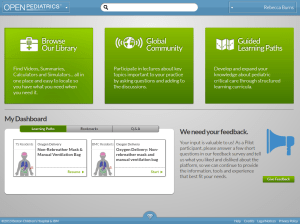
3d585a21-b04b-4305-8afe-5196323566aeThere is a shortage of physicians and nurses across the world skilled in the care of ill children, and training on how to expertly treat children with life-threatening illnesses is only available at relatively few teaching hospitals across the world. In response to these needs, Boston Children’s Hospital and IBM launched OPENPediatrics – a peer-reviewed, open-source, and not-for-profit education platform providing information on best practices for the care of critically ill children to healthcare providers around the world.

The OPENPediatrics platform focuses on three things:

  • giving doctors access to the data-driven tools they need to make critical decisions
  • providing a structured learning program for doctors to gain advanced training, and
  • providing access to a global community focused on the care of critically ill children.

Access the OPENPediatrics website at: http://openpediatrics.org/

Some of the resources created for the OPENPediatrics site — including those in the new multimedia library — are now being made available to the general public as well. Alongside the monthly expert videos, there are an initial 48 animations and illustrations (with many more to follow) which have been released under a Creative Commons CC BY-NC-SA licence so that clinicians and academics may use them in their own instructional materials. As the platform grows, content will extend beyond critical care.

Overall, OPENPediatrics is a very impressive innovation and it is easy to imagine the model being applied to other health disciplines around the world.