Free Autism Spectrum e-books

NIMH a-parents-guide-to-autism-spectrum-disorder2

Starting or extending your personal Autism reference library? Begin by trying these four free, reputable e-books written for the public (with or without Autism), parents and professionals.

A Parent’s Guide to Autism Spectrum Disorder (2011) by the US National Institute of Mental Health (NIMH) .
This short guide is intended to help parents understand what autism spectrum disorder (ASD) is, recognize common signs and symptoms, and find the resources they need. It is a useful 27-page book  offered in Epub and Mobi formats for e-readers, alongside the common PDF format, and it is also published in Spanish.  public_domain_logo-69px

Ohio’s Parent Guide to Autism Spectrum Disorders (2009) from OCALI – The Ohio Center for Autism and Low Incidence.
This 274-page manual provides an overview of the world of autism spectrum disorders. It was developed by Ohio parents, for Ohio parents, with examples provided from their experiences. The information included in the manual is a result of their answers to the question: When your child was first diagnosed, what information did you need most?
The manual covers a wide range of topics of interest to families, and each chapter contains rich reference materials, including books, websites, and names of organizations where additional information on each topic may be obtained.

A Spectrum of Relationships (2011) by C. S. Wyatt
The author reflects on his own experiences as a diagnosed high-functioning autistic individual navigating the complex and sometimes frustrating social situations of daily life. This is a free 81-pages-long abridged edition in ePub format. It can be downloaded from the author’s popular blog The Autistic Me, which features more reflections on daily life with autism from his perspective of a university professor.
IACAPAPFinally, section C2 of the IACAPAP Textbook of Child and Adolescent Mental Health (2012) covers autism spectrum disorders.
The 
IACAPAP Textbook is a global publication by the International Association for Child and Adolescent Psychiatry and Allied Professions in Geneva, and is intended for professionals training or practising in mental health and not for the general public. This colourful 27-page chapter can be downloaded as a PDF. CC by nc

Parental mental health and families by SCIE

Parental mental health and families

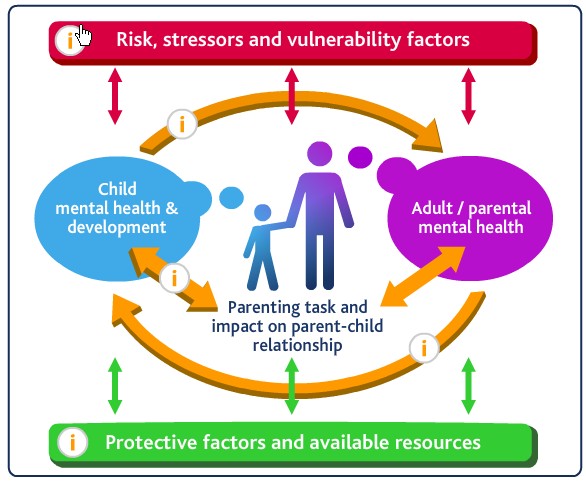
The Parental mental health and families eLearning package from the UK’s Social Care Institute for Excellence (SCIE) sets out all the key relationships, linkages and systems that need to be understood in parental mental health and families work. The materials look at the ways current organisational structures may not be working for families affected by parental mental ill health and what changes might be beneficial. In a unique move, the material asks the professionals to step into parents shoes to try and understand some of the difficulties and frustrations they may experience. This package comprises eight modules:

  1. Introducing the family model
  2. Think child, think parent and think family
  3. Working together with parents
  4. Working together with professionals
  5. Care planning and review
  6. Interventions
  7. Managing complexity and leading practice
  8. Communicating with families

Each module is about 20-30 minutes long. They include glossaries, references, transcripts, learning records and links to extra resources. Adobe Flash Player is required on your computer. The interactive modules provide accurate information in an engaging way, and the references and links to extra resources allow the learning to be extended far beyond the original module.
Link: www.scie.org.uk/publications/elearning/parentalmentalhealthandfamilies/index.asp
Use of this resource, and import of the resource into learning management systems, for educational purposes is freely permitted. A SCORM version is offered for free download and use in a virtual learning environment (VLE).

Understanding Attachment Theory by IRISS

Attachment by IRISSThe basic principles of attachment theory – and why it’s important – presented in a multimedia animation.
This resource defines attachment, examines the components of attachment theory, patterns of attachment behaviour as well as attachment, abuse and neglect.

This is one of 22 multimedia learning resources published by IRISS – Scotland’s Institute for Research and Innovation in Social Services. The resources are designed for social work students and practitioners, but will also be valuable to others working with children and families, such as foster and adoptive carers.
Understanding Attachment Theory is a self-contained package including text transcripts, references and a glossary, divided into seven sections:
1. Defining attachment
2. The biological imperative
3. Main components of attachment theory
4. Patterns of attachment behaviour
5. Insecure attachment
6. Attachment is the product of a relationship
7. Attachment, abuse and neglect

The presentation will take at least 10-15 minutes, depending on your knowledge of the subject. I think the presentation summarizes the concepts well, but students are likely to need more up-to-date references than 1995. As with other IRISS resources, I appreciate how easy it is to navigate between the individual elements.

Link: http://content.iriss.org.uk/understandingattachmenttheory

This multimedia presentation requires Adobe Flash Player on your computer, and the package cannot be downloaded for offline use. Copyright © Institute for Research and Innovation in Social Services 2006. All rights reserved.