Tag Archives: parenting

New Year OBEs for ‘Netmums’ founders

netmumsSarah Russell, Siobhan Freegard and Cathy Court, the three founders of the parental support website Netmums, received OBEs for services to families in the UK New Year Honours list. Congratulations to each of them, as they have built an excellent community.

Netmums was set up in 2000. It now has over 1.6 million members and alongside the self-help conversations on the forums, trained Parent Supporters or Health Visitors help about 3500 individual mums each month, calling on experts from Relate, Women’s Aid, Contact a Family, Family Rights Group and the Citizen’s Advice Bureau. Netmums satisfies all the criteria for being classified as a ‘self-educating community’, which Leigh-Anne Perryman and I wrote about in our Public-Facing Open Scholar paper. Netmums also compares favorably to the Facebook groups that I highlighted in May 2013 for being particularly educative. Like the best Facebook groups, Netmums is open for the public to read the forum conversations, and as no Facebook account is needed to view them, Netmums can reach an even wider audience.

I wrote in May 2013 that it is helpful to belong to a community to support your learning, so if you are interested in parenting but don’t yet belong to an online community, Netmums is a very good place to begin.
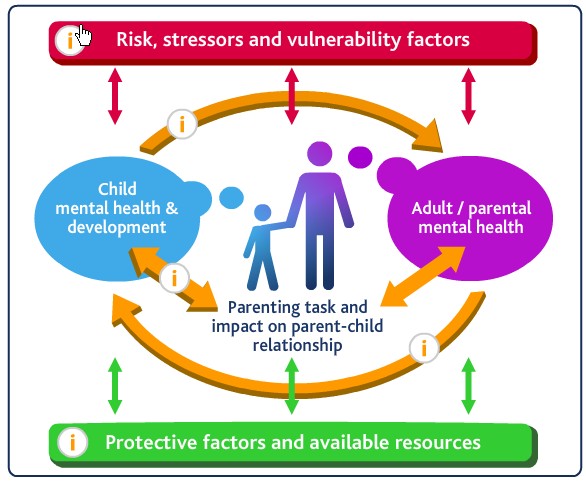

Parental mental health and families by SCIE

Parental mental health and families

The Parental mental health and families eLearning package from the UK’s Social Care Institute for Excellence (SCIE) sets out all the key relationships, linkages and systems that need to be understood in parental mental health and families work. The materials look at the ways current organisational structures may not be working for families affected by parental mental ill health and what changes might be beneficial. In a unique move, the material asks the professionals to step into parents shoes to try and understand some of the difficulties and frustrations they may experience. This package comprises eight modules:

  1. Introducing the family model
  2. Think child, think parent and think family
  3. Working together with parents
  4. Working together with professionals
  5. Care planning and review
  6. Interventions
  7. Managing complexity and leading practice
  8. Communicating with families

Each module is about 20-30 minutes long. They include glossaries, references, transcripts, learning records and links to extra resources. Adobe Flash Player is required on your computer. The interactive modules provide accurate information in an engaging way, and the references and links to extra resources allow the learning to be extended far beyond the original module.
Link: www.scie.org.uk/publications/elearning/parentalmentalhealthandfamilies/index.asp
Use of this resource, and import of the resource into learning management systems, for educational purposes is freely permitted. A SCORM version is offered for free download and use in a virtual learning environment (VLE).

Understanding Attachment Theory by IRISS

Attachment by IRISSThe basic principles of attachment theory – and why it’s important – presented in a multimedia animation.
This resource defines attachment, examines the components of attachment theory, patterns of attachment behaviour as well as attachment, abuse and neglect.

This is one of 22 multimedia learning resources published by IRISS – Scotland’s Institute for Research and Innovation in Social Services. The resources are designed for social work students and practitioners, but will also be valuable to others working with children and families, such as foster and adoptive carers.
Understanding Attachment Theory is a self-contained package including text transcripts, references and a glossary, divided into seven sections:
1. Defining attachment
2. The biological imperative
3. Main components of attachment theory
4. Patterns of attachment behaviour
5. Insecure attachment
6. Attachment is the product of a relationship
7. Attachment, abuse and neglect

The presentation will take at least 10-15 minutes, depending on your knowledge of the subject. I think the presentation summarizes the concepts well, but students are likely to need more up-to-date references than 1995. As with other IRISS resources, I appreciate how easy it is to navigate between the individual elements.

Link: http://content.iriss.org.uk/understandingattachmenttheory

This multimedia presentation requires Adobe Flash Player on your computer, and the package cannot be downloaded for offline use. Copyright © Institute for Research and Innovation in Social Services 2006. All rights reserved.